

Ask three security or IT management tools how many servers you have, and you’ll probably get three different answers. The Configuration Management Database (CMDB) has one count, the Endpoint Detection and Response (EDR) platform another and the vulnerability scanner a third, and each is accurate from its own point of view. Together, they leave security teams unsure about the one thing every other process depends on: what’s actually out there, who owns it and how much it matters.
That’s why adding more discovery tools rarely helps. The issue isn’t a shortage of data, it’s that nothing reconciles the data you already have into a single record you can trust, or adds the context that turns visibility into decisions. That combination is asset intelligence.
This is the first post in Prevalent AI in Action, a series on how Prevalent AI’s Context Engine solves specific security challenges, as well as addressing broader IT and AI related issues.. We are starting with asset intelligence as this is the foundational problem that every other security programme is built on.
Exposure management can’t prioritise risks on assets it doesn’t know about, controls monitoring can’t prove coverage across an estate nobody has fully mapped, and compliance reporting is only as reliable as the inventory underneath it.
When asset intelligence comes from one consolidated view, every team builds on the same foundation, and security operations, risk and the board can align on the same numbers instead of debating whose are right.
What is asset intelligence?
Asset intelligence is an accurate, continuously updated understanding of every asset in your environment, the relationships between them and the context needed to act. It starts with asset visibility, knowing what exists across servers, endpoints, cloud workloads, applications and identities, and builds on it by connecting each asset to the others: which applications run on which servers, which identities can access which systems, who owns each asset, how it’s configured and how much it matters to the business. Without it, every other security process is working from guesswork.
The analyst firm SACR defines asset intelligence as technologies that ‘transform fragmented asset observations into timely, traceable, and decision-grade context for security operations’.
In practice, asset intelligence means being able to answer four questions about every asset:
- What is it? Its type, software, configuration and where it runs.
- Who owns it? The person or team accountable for keeping it secure and fixing it when something goes wrong.
- What’s wrong with it? Its vulnerabilities, misconfigurations and missing or broken controls.
- Why does it matter? Whether it’s internet facing, what data it holds, which compliance requirements apply and how critical it is to the business.
That’s the difference between asset intelligence and an asset list. A list confirms something exists and, while intelligence gives you enough context to make a decision about each asset, and keeps that picture current as cloud workloads spin up and down, devices change hands and people leave the business.
It also has to cover every kind of asset, seen from both the inside and the outside. Attackers don’t limit themselves to what’s in the CMDB, so visibility needs to extend to cloud resources, SaaS applications, OT and IoT devices, and identities, whether those belong to people, machines or AI agents. Attackers also often start from the outside, scanning for internet-facing systems, forgotten domains and exposed services that internal tools may never have recorded. Combining that external view with what your internal tools report shows your attack surface the way an attacker sees it.
Why do security teams still lack asset intelligence?
Asset intelligence breaks down because every tool sees the environment from its own angle, and nothing reconciles those views into one record. Adding another discovery tool usually adds another partial list, and it is a challenging process for most organizations to reconcile information from multiple tools today.
In practice, that looks like:
- Duplicates. The same server appears three times under a sometimes differing hostname, an IP address and a cloud instance ID, so counts and coverage metrics are wrong from the start.
- Conflicts. The CMDB says a device is decommissioned while the EDR agent is still reporting from it, and there’s no rule for which source wins.
- Stale data. Ownership records point to people who have changed roles or left the company, so findings land with nobody.
- Missing context. A scanner can tell you a vulnerability exists, but not whether the asset is internet facing, holds customer data or falls under PCI scope.
- Ephemeral assets. Cloud workloads, containers and serverless functions can exist for days, hours, or even minutes. A point-in-time scan can miss them entirely, yet a short-lived instance with a vulnerability or misconfiguration is still exposed while it runs, and still matters during an investigation after it’s gone. Visibility has to track assets continuously, including the ones that no longer exist.
Is the CMDB enough for asset intelligence?
A CMDB is a useful source, but it isn’t a source of truth on its own. CMDB data quality depends on manual updates and change processes that rarely keep pace with cloud workloads, short-lived infrastructure and staff turnover. Treated as one input among many, and checked against what security tools actually observe, it becomes far more reliable.
The 2024 Change Healthcare breach shows what this costs. In testimony to Congress, UnitedHealth Group’s CEO confirmed that attackers got in using stolen credentials on an internet-facing Citrix remote access portal that didn’t have multifactor authentication. Nine days later, they deployed ransomware and the breach went on to affect the data of around 190 million people.
Microsoft’s breach by Midnight Blizzard the same year started in a similar place, with a legacy test account that had no MFA but was connected to an application with elevated access to the corporate environment. Neither organisation lacked security tools. What was missing was a reliable answer to three questions: which systems are exposed, which controls are actually in place on each one, and who owns them?
How does Prevalent AI generate asset intelligence?
Prevalent AI creates asset intelligence by connecting every tool’s data into one resolved record per asset, including the context that explains why each asset matters. Instead of replacing your existing tools, it cleans and contextualises the data you have to make it actionable.
Prevalent AI’s Data Fabric, built over nearly a decade inside some of the world’s most complex enterprise environments, does this in four steps:
- Ingest from every source. Data comes in from CMDBs, endpoint, vulnerability, cloud, identity and network tools, with new sources added as the environment changes.
- Resolve entities. Records describing the same asset are matched and merged into a single entity, so one server is one server, however many tools report it.
- Choose the trusted value. For each attribute, the Data Fabric takes the value from the most trusted source, or the most recent one, and keeps a record of where every detail came from. When someone asks why the inventory says what it says, the answer is traceable.
- Connect the context. Each asset is linked in a Knowledge Graph to its owner, applications, vulnerabilities, controls, data sensitivity and compliance scope.
The result is an inventory you can act on, because it shows not only what exists but how each asset relates to people, risks and the business.
Asset intelligence in action: finding every server exposed to a critical PHP flaw
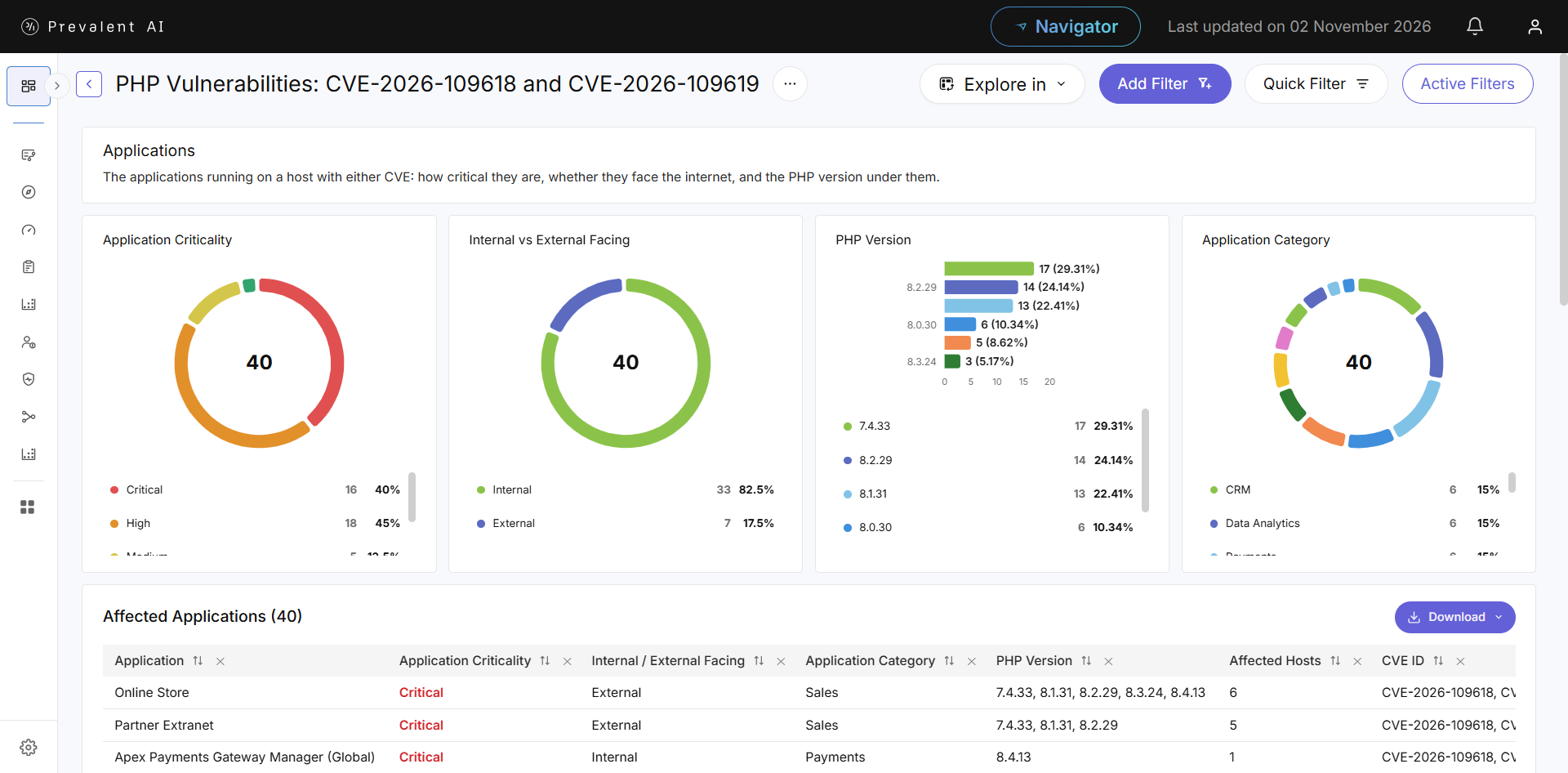
To see the difference in practice, we can look at the recent PHP2Shell vulnerability which is still creating significant work for security teams. On October 21st 2026, the PHP project released emergency fixes for two critical flaws, CVE-2026-109618 and CVE-2026-109619, which let attackers run code on a server without logging in.
According to the SANS Internet Storm Center, all versions of PHP were vulnerable with patches made available for the latest versions only.
The level of risk associated with this particular vulnerability was such that guidance provided recommended that organizations take their systems offline if they were not able to patch quickly.
For most security teams, the hardest part of a vulnerability like this isn’t applying the patch, but working out where PHP is actually running. It sits inside web servers, content management systems (CMS), internal tools and vendor appliances that rarely show up in a single inventory, so the scenario below is one many teams faced recently: a critical, unpatched PHP vulnerability, somewhere in a large estate.
Start with the assets that carry the most exposure
Rather than a flat list of findings, Prevalent AI’s exposure management dashboard ranks devices by overall exposure. Drilling into servers surfaces one with several problems at once:
- An active, unpatched PHP installation vulnerable to PHP2Shell
- A direct connection to the internet
- A business critical application
- An endpoint protection tool that’s still not fully onboarded
- A device owner marked as inactive
Any single tool might have reported one of these. Only a resolved view of the asset shows all five together, including the ownership gap that would leave the fix with nobody, which is what security leaders need to understand the aggregate view of the risk.
See why it matters to the business
The server’s exposure score is high because of its context, not only its findings. It’s an internet-facing production server holding customer data, running critical applications and in scope for PCI compliance. The Knowledge Graph weighs factors such as ownership, accessibility and the sensitivity of the data in the applications it supports, which is what separates a critical asset from a noisy one.
Hunt across the whole estate
The same Knowledge Graph supports threat hunting across every asset. Searching for all devices running a vulnerable version of PHP returns the full list. Filtering for devices with no vulnerability management tool installed narrows it down, and filtering again for devices still owned by employees who have left the company pinpoints vulnerable devices that no team would otherwise have picked up.
That last query combines software inventory, security tool coverage and HR ownership data. It’s only possible because those sources have been resolved into one model, and it answers the questions that matter the most when a vulnerability is announced: where is this running, is it protected, and who owns it?
To see what this looks like across your own estate, the Knowledge Graph applies the same resolved view to every asset you have and ranks each exposure by the risk it actually carries.
Why asset intelligence matters beyond the inventory
Asset intelligence is the foundation for everything that follows, from exposure management to the AI agents security teams are starting to rely on.
It turns findings into fixes. Prevalent AI’s Knowledge Graph supports exposure management use cases in four layers: discover, assess, prioritise and remediate. Discovery comes first, ranking every asset by business impact. Assessment then checks each one for control gaps, software vulnerabilities and misconfigurations. Prioritisation focuses effort on the most critical exploitable exposures, and remediation traces vulnerabilities to their root cause so teams can apply the fixes that remove the most risk for the least effort. None of these layers are reliable if the asset data underneath it isn’t.
It gives AI agents trusted context. An AI agent querying raw data has to find and reconcile duplicate records itself, which costs tool calls and tokens and introduces errors. Querying a resolved Knowledge Graph, that work is already done, which is why AI built on trusted enterprise context performs better.
It supports compliance. Because every asset carries its context and every fact carries its source, mapping security posture against industry frameworks becomes a query, not a project.
Want to find out more how Prevalent AI can help you support these use cases? Sign up for a demo of the technology in action.
FAQs
What is the difference between asset discovery, asset visibility, and asset intelligence?
Asset discovery finds individual assets in your environment. Asset visibility combines those discoveries into a complete view of everything that exists. Asset intelligence builds on that view, adding the relationships between assets and the context of their owners, configuration, risks and business importance, so teams can make decisions about each one.
What is a cybersecurity asset inventory?
A cybersecurity asset inventory is a list of every asset that could affect your security posture, including devices, cloud resources, applications and identities. A useful one is deduplicated, kept current automatically, and linked to the vulnerabilities and controls that apply to each asset.
Why is my CMDB inaccurate?
CMDBs rely on manual updates and change processes that struggle to keep up with cloud infrastructure, short-lived workloads and staff changes. Comparing CMDB records against what security tools actually observe exposes the gaps and keeps ownership data current.
How does asset intelligence help with exposure management?
Exposure management depends on knowing which assets exist, who owns them and how important they are. With asset intelligence, teams can prioritise exposures by business impact and route fixes to the right owner, instead of working through an unranked list of findings.